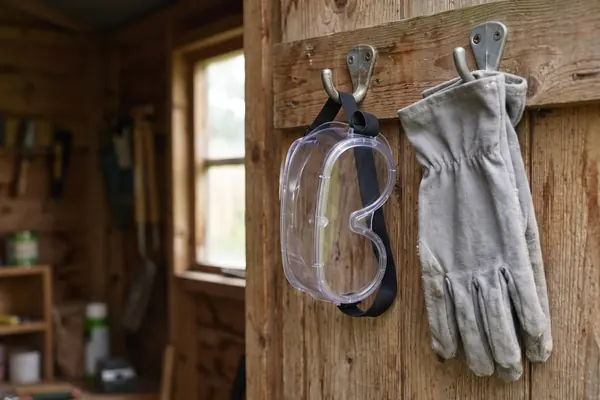
MARKINGS
Read the arm and the lens
Lenses carry the maker's mark, an optical class (1 is best) and an impact grade such as S or F. Frames carry the maker's mark, EN 166 and their own grade.
Check a mark targetspecs
WHAT THE MARKINGS SAY
The tiny letters on safety glasses are test results.

S · F · B · A impact grades
45 m/s Speed of the steel ball in the F test
Under the eye protection standard EN 166, each mark on the lens or frame records a test it passed: how hard a steel ball can hit it, whether it keeps out dust or splashes, whether it resists fogging. Knowing a handful of them helps you pick the right pair for the job.
THE SHORT ANSWER
Lens marks, frame marks and field-of-use numbers
each tell you something different.
MARKINGS
Lenses carry the maker's mark, an optical class (1 is best) and an impact grade such as S or F. Frames carry the maker's mark, EN 166 and their own grade.
Check a markGOGGLES
The field-of-use marks 3 (liquid droplets), 4 (coarse dust) and 5 (gas and fine dust) appear on goggles, not on ordinary spectacles.
Pick the right typeIF IT HAPPENS
The NHS says to wash an eye with clean water if something is in it, running lots of water over it for at least 20 minutes.
See the numbersA QUICK MARK CHECK
Pick the impact grade printed on the lens or frame to see what it was tested against. The bar shows how hard an impact that grade is rated for.
Based on the Association of British Dispensing Opticians' reference guide to EN 166. Check the maker's instructions for your own pair.
CHOOSING A PAIR
HSE lists the hazards to eyes as chemical or metal splash, dust, projectiles, gas and vapour, and radiation, and says protection should suit the task and fit the wearer.

Flying chips from drilling or sawing are an impact hazard; sanding dust, paint spray and splashing liquids need a seal around the eyes.
Spectacles go up to impact grade F. For grade B, droplets (3), coarse dust (4) or fine dust and gas (5), the marks appear on goggles or faceshields.
Look for EN 166 and the grade on the frame, and the optical class and grade on the lens. HSE says most new PPE sold in Great Britain must be UKCA or CE marked.
ABDO advises cleaning as instructed, storing in the case and avoiding solvents such as acetone on polycarbonate lenses. Repairs go back to the original supplier.
TWO NUMBERS WORTH KNOWING
One figure from the impact test behind the F mark,
one from NHS first aid advice.
45 m/s
Speed of the steel ball in the F test
A 6 mm, 0.86 g ball. F is the top grade for spectacles; grade B (120 m/s) needs goggles or a faceshield, grade A (190 m/s) a faceshield.
IMPACT TEST · EN 166
20 min
How long to run water over an eye with something in it
At least 20 minutes, using clean water that is not hot, with a flow that is not too strong. For a strong chemical such as oven cleaner or bleach, keep rinsing and go to A&E or call 999.
FIRST AID · NHS
Sources: ABDO reference guide to BS EN 166:2002; NHS, Eye injuries (reviewed March 2026).
WHY THE MARKS MATTER
EN 166 sets the tests behind the marks: optical quality (class 1, 2 or 3, with 1 the best), mechanical strength (S, F, B, A) and fields of use such as liquids, dust and molten metal. Extra lens marks include K for resistance to damage by fine particles and N for resistance to fogging.
Filter lenses add a scale number before the other marks: 2 or 3 for ultraviolet filters, 4 for infrared and 5 or 6 for sunglare, followed by a shade number. Higher numbers filter more strongly.
Questions
F means low energy impact: the lens or frame withstood a 6 mm, 0.86 g steel ball travelling at 45 metres per second. ABDO describes F as the highest impact grade protective spectacles offer.
Not as eye protection. Protective eyewear is tested and marked to EN 166. If you wear prescription glasses, opticians can dispense prescription protective eyewear made by a recognised safety eyewear manufacturer.
They are fields of use marked on the frame: 3 for liquid droplets or splashes, 4 for coarse dust, 5 for gas and fine dust, and 9 for molten metal and hot solids. Ordinary spectacles do not carry them.
K means the lens resists surface damage by fine particles, and N means it resists fogging. Both are optional extra marks under EN 166.
The NHS says to wash it with clean, not hot, water for at least 20 minutes and not to rub it. Go to A&E or call 999 for a strong chemical, a pierced eye, a high-speed hit or any change in sight.
Updated
ABOUT THIS NAME
targetspecs.com is part of the DoodleSale portfolio. It isn't in an auction right now, but you can ask about leasing it.